 Update: Eharmony is not in fact offering background checks. The RelyID is an identity authentication service only. I confused the fact that RelyID has access to criminal data, which is described in the press release, with background checks.
Good news for online daters, dating sites are starting to adopt background checks identity authentication services.
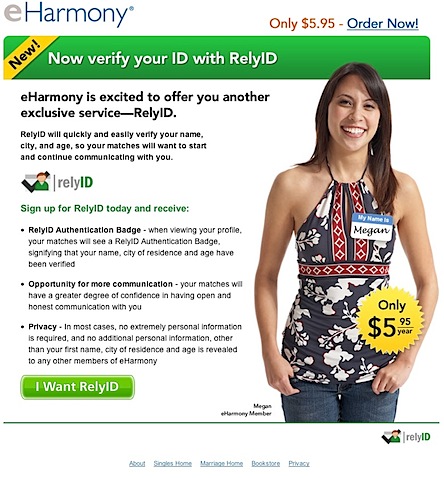
Today eHarmony announced the release of eHarmony RelyID, a new online ID verification service for eHarmony members. The service, which is a partnership with RelyID, a leading provider of age and identity verification services, gives eHarmony members the opportunity to easily validate key profile details which are viewed by other potential matches.
RelyID provides real time Identity Verification tools to consumers as well as businesses via a user-friendly web-based applications utilizing Knowledge Based Authentication.
RelyID’s extensive collection of accurate and up-to-date public records enables them to provide identity verification and information to businesses and consumers instantly. Additional services include access to the nation’s largest criminal screening database containing more than 300 million instant criminal records updated from direct sources on a monthly basis and verification of education, employment and professional certifications. The service is non-intrusive to consumers, maintains privacy while at the same time helping businesses prevent fraud and increase revenues.
 RelyID is brought to you by Backgroundchecks, a leader in the background check industry. My good friend Pat Mangiacotti, charged with business development duties at Backgroundchecks.com, is a VP at RelyID. Pat and I worked together at Trufina and it’s great to see her years of hard work paying off.
Don’t think, as I mistakenly did, that eHarmony is doing a generic background check, there is a lot more to the system than a simple database lookup. First you have to make sure the party being checked is who they say they are. This identity verification service is accomplished via a series of “out of pocket” questions which only you should know about yourself. This portion of the process reveals past mailing addresses. Backgroundchecks.com and other services have showed me apartment addresses from 20 years ago.
Once a person is authenticated, then the background check is performed and relevant icons and badges are added to your eHarmony profile. The cost of the identity verification service is $5.95 per year.
 RelyID is capable of querying goes out and queries databases, more than 2,000 if my memory serves correct. Most of the databases are accessed via companies like Choicepoint and others which aggregate all sorts of criminal and other databases.
How long have we been talking about Background checks and identity verification services here, three years at least? I expect the dating industry to quickly adopt identity verification services and background checks now that a top player has taken the plunge. Just like how it happened with anonymous calling.
The RelyID User Agreement reminds me of some of the personality testing Terms of Service, which tend to state that tests are for entertainment purposes only.
RelyID states:
For example, we make no warranties, representations, or guarantees that the RelyID service is accurate, complete, or current or that it will operate without interruption or error or that it is merchantable, fit for a particular purpose, or suitable for you.
You agree that we have no liability to you related to the RelyID service, even if we are negligent. In particular, we are not liable for any consequential damages (including lost opportunity, profits, use, or savings) or incidental damages, even if advised of their possibility, or punitive damages.
You agree to pay for our defense of any third party’s claim related to your breach of any of these terms or related to your negligence or wrongful act or omission related to the RelyID service. You agree to pay any settlement or judgment entered for any such claim.
The RelyID value proposition is not sounding so good at this point. Why am I being asked to try a service that doesn’t promise me anything of value and actually puts me in financial jeopardy? Where is the value to the consumer? The best-effort background check or the Verified icon on profiles?
I’m not a lawyer, but this made my head spin, it’s like selective enforcement.
If any of these terms are illegal or unenforceable, those terms will be removed and the remaining terms remain enforceable.
Granted I’m picking on the legal verbiage here, but isn’t that the first place you should go when deciding if an identity verification services background check is right for you? If the value proposition to the user is this unsettling, perhaps we need to evaluate the legality of background checks and identity verification services themselves.
What happens if I, a devious criminal, attack someone on a dating site, even though I have passed the background check? What about people that haven’t been caught yet? Is it illegal to falsify a criminal check?
More questions than answers for now. In short, background checks and identity verification services are a good thing for the online dating industry. Background checks are more about perception than reality, whereas identity verification services are fairly straightforward. Some dating sites will demand them, others, like eHarmony, will offer them as a value-added service, hoping that a Verified icon on a profile will make people feel better about contacting you, which will drive more members and revenue. Verification services are all about revenue, don’t forget it. dating sites won’t offer them unless they see money on the table or are legally bound to do so.
Identity verification services and Background checks will also further separate casual from serious daters and the sites the frequent.
I am interested to see what the social implications of identity verification services and background checks will be on dating sites. will they help or hinder? What sort of adoption rates are we looking at, single-digits or widespread? What do you think will happen?
Press Release.