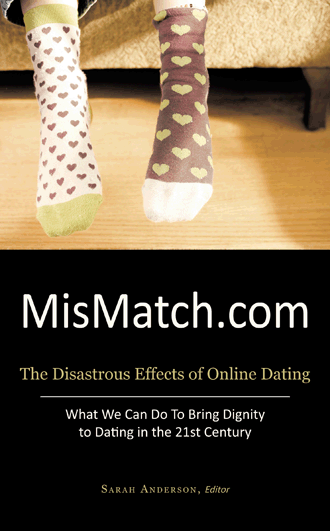
The Disastrous Effects of Online Dating provides new rules for 21st Century dating, what you can do when the rules are broken, and ways to get through the tough times. Learn what men and women think of the new rules, read typical online dating profiles of men and women, and listen to first-hand experiences with online dating. Finally, we hit the pause button for a moment to consider ways we can instill more dignified dating and make the modern views of monogamy and commitment work for us.

Related posts:


{ 6 comments… read them below or add one }
hey! dating info is really rock
Wow, this book looks awful, just awful!
Granted, I’ve only read the introduction on their website, but if that’s any indication of the rest of the book than the authors our suffering from delusion.
In the intro, the author tries to peg the infidelity of particular high status men on the online dating industry like Match dot com… WTF?! I can’t believe the author is actually serious. She goes on to point out how poorly women are treated by the men who “can’t commit” and all their hardships, blah blah blah, all because of online dating. This of course is complete rubbish.
As most men who pursue online dating know, the odds our incredibly skewed in favor of women. It is the women who have the pick of the litter; it is the women who are getting contacted by hundreds of potential suitors; and it is women who generally have the options in the online dating realm, not men.
Of course, the author has the audacity to point out two examples of online dating men who have dated over 200 women! Let me tell you, as someone who has been researching this stuff for a couple of years now, I can tell you that the men interviewed in this book are the exceptions, not the norm. Most men would be hard pressed if they could get 1 date, let alone 200. The men interviewed are most likely extremely attractive alpha male types who would naturally attract a lot of women regardless of the venue, online or off.
The issue with the author seems to be that her standards are way too high. She expects that the average women on the Internet should be able to land a guy of extremely high quality who will also commit – to an average woman. They are all living in a pipe dream!
There are millions of nice decent guys on online dating sites who ARE willing to commit, but are largely ignored because of the high bar that women have set. If they could only realize that if they dated someone on their OWN level, they might actually find a meaningful relationship, with someone who can commit.
By the way, blaming male infidelity on online dating is the biggest friggin’ cop out I have ever heard. Male infidelity is as old as humans have existed and the reasons are a lot more biological than anything that the Internet could do.
Dave, sorry for the rant in your comments, but it’s this kind of stuff that really gets on my nerves.
Ah crap, in my haste to get my thoughts on the screen, I made some glaring grammatical mistakes. Dave, would you be willing to change the “our”s in the second and fourth paragraphs to “are.” Thanks, and you can delete this comment too since it doesn’t really add to the conversation.
I can understand what the author is trying to do, but it’s not going to help because the medium of online dating isn’t to blame.
People are responsible for their own behavior and always have been. If a man and woman want to have flings rather than relationships, that is their business. Online dating hasn’t caused or contributed to that.
Brandon
Does anyone have any proof that men cheat more than women? If you filter out the serial male daters its probably higher among women…
Have you seen this paper about Higher IQ linked with atheism, liberalism, and monogamy ?
“And the U.S. data show a relationship between male adolescent intelligence and how much, as adults, they came to value sexual exclusivity. The more intelligent the male respondents were, the more they believed in monogamy.”
paper “Why Liberals and Atheists Are More Intelligent”
http://personal.lse.ac.uk/Kanazawa/pdfs/SPQ2010.pdf
The origin of values and preferences is an unresolved theoretical question in behavioral and social sciences. The Savanna-IQ Interaction Hypothesis, derived from the Savanna Principle and a theory of the evolution of general intelligence, suggests that more intelligent individuals may be more likely to acquire and espouse evolutionarily novel values and preferences
(such as liberalism and atheism and, for men, sexual exclusivity) than less intelligent individuals, but that general intelligence may have no effect on the acquisition and espousal of evolutionarily familiar values (for children, marriage, family, and friends). The analyses of the National Longitudinal Study of Adolescent Health (Study 1) and the General Social Surveys
(Study 2) show that adolescent and adult intelligence significantly increases adult liberalism, atheism, and men’s (but not women’s) value on sexual exclusivity.